I had a hunch that our funnel was lying to us. Not maliciously. Just quietly, by not knowing where to look.
When a customer hits a checkout error and doesn’t complete their purchase on the website, the funnel report marks it as lost. That felt too tidy to me. So I asked: what if they just called in instead?
Channel shift vs. drop-off
Most funnel analysis is channel-blind, and I think that’s a genuinely underappreciated problem. It tracks a user through a sequence of digital touchpoints and calls anything that doesn’t end in a conversion a failure. But customers don’t think in channels. When friction appears in one place, some of them just continue elsewhere. Very reasonable behaviour, actually.
The question I started asking is not just “did they convert?” but “did the friction cause them to not convert at all, or just to complete through a different channel?”
Those two outcomes look identical in a standard digital funnel. They’re not. One is a lost sale. The other is a sale that nearly went uncredited.
Journey Canvas in CJA
I’ve been playing with Journey Canvas in Customer Journey Analytics for exactly this kind of cross-channel sequence analysis. Rather than showing fallout from a fixed digital path, it lets me define sequences across touchpoints and see where users actually go, not just where they leave.
The two hypotheses I set up for a checkout-error scenario:
- Checkout → Error → Call Centre → Order
- Checkout → No Error → Call Centre → Order
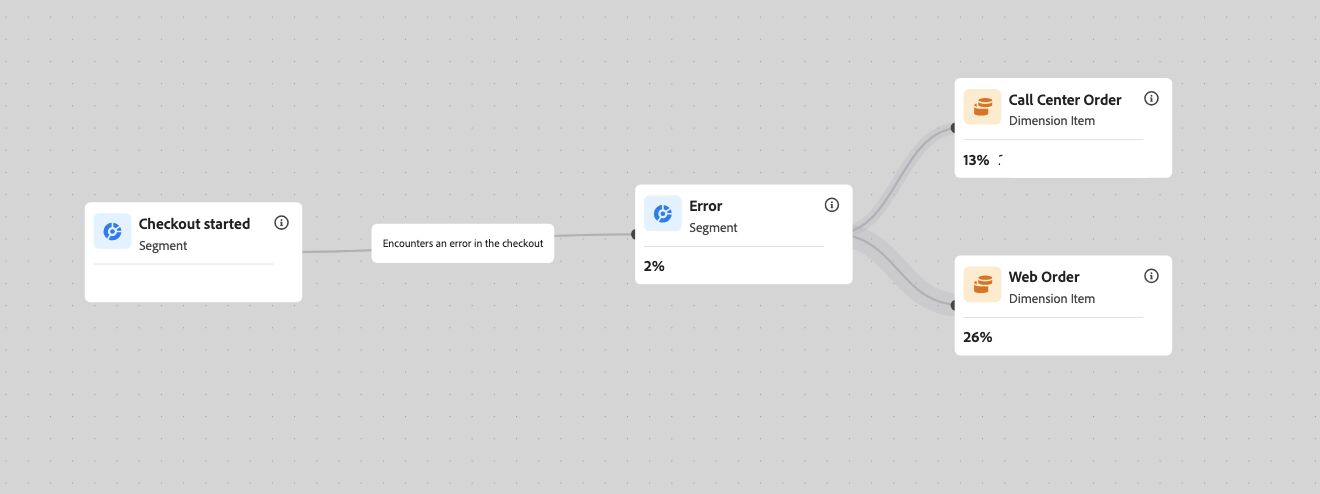
Both paths end in a call centre order. The interesting question is whether the error is correlated with the channel shift: is the friction creating call centre volume that wouldn’t otherwise exist?
If the first sequence is significantly more common than the second, I have something worth showing the team. The conversion rate looks fine on paper. The call centre is quietly absorbing what the website broke.
A few things I learned to watch out for
Journey Canvas makes it very easy to find sequences that look meaningful but aren’t. I’ve made that mistake.
Time constraints matter. An order that happens six weeks after a checkout error probably isn’t caused by it. I set a window that reflects realistic decision timelines for the product: hours for low-consideration purchases, a few days for anything more considered.
Always compare against a baseline. How often does Checkout → Call Centre → Order happen without an error step? If it’s nearly as common, the error isn’t really doing much. The sequence only means something in relation to the baseline.
Mind the sample size. Cross-channel paths are often rare. A compelling-looking sequence with 40 users in it is a hypothesis, not a finding. I’ve learned to say “interesting, let’s investigate” rather than “here’s what’s happening.”
What this changed for me
Once I could see cross-channel sequences, “abandoned” stopped being a terminal verdict. It became a branch point: users who left the digital path went somewhere, and some of them came back through another channel. Journey Canvas lets me follow them.
The funnel didn’t end. I just wasn’t watching the right thing.
Join the discussion
Leave a comment